Choosing a bath mat that dries out instead of staying damp

Bath mats get bought for how they look and judged, a month later, on whether they smell. The difference between a mat that stays fresh and one that does not is almost entirely about how quickly it releases the water it absorbs, which comes down to pile structure, backing and how you wash it.
Absorbency and drying speed are different properties
A mat needs to take water off your feet quickly, and then give it back to the air quickly. Those are not the same thing, and a mat that is excellent at the first and poor at the second is exactly the one that develops a smell.
Dense chenille and microfibre do both reasonably well because the individual fibres are fine and there is air space between them. A thick foam-cored mat absorbs well and dries slowly.
The backing decides whether the underside ever dries
A solid rubber or PVC backing stops water reaching the floor, which is useful, but it also stops air reaching the underside of the mat. Water that has soaked through sits between mat and floor.
Backings with a dotted or gridded pattern grip nearly as well while letting the underside breathe. For a bathroom without much ventilation, that difference is significant.
Hang it up, and most of the problem disappears
A mat left flat on the floor dries from one side only. Hung over the side of the bath or a rail after use, it dries from both, and typically in a fraction of the time.
This single habit does more for freshness than any material choice, and it costs nothing.
Wash cool and skip the softener
Fabric softener coats fibres, and coated fibres absorb noticeably less. It is the most common reason a mat that worked well when new stops feeling absorbent after a few months.
Wash at a moderate temperature without softener and the pile keeps its absorbency. Vinegar in the rinse is a reasonable substitute if you want softness.
Heat is what kills the pile and the backing
A hot dryer mats down chenille and can crack or peel a rubber backing. Once the backing has gone brittle it sheds, and the mat is finished regardless of the condition of the pile.
Low heat or air drying keeps both intact. It takes longer and it roughly doubles how long the mat lasts.
Size it to where you actually stand
The most common sizing error is a mat too small for the space in front of the bath, so you step off the edge onto a wet floor. Measuring the usable floor area before buying avoids it.
A runner-length mat suits a long vanity or a double basin, where a standard rectangle leaves the ends of the counter unprotected.
The mats we carry
The chenille mats on this shelf are the dense, quick-drying kind, and the listings give the dimensions so you can check them against your floor. On our own shelf that range currently runs from $16.99 for the HAMITOR 2-Pack Modern Bronze Toilet Brush Set with Holders for Deep Cleaning up to $39.70 for the Brighter Barns Luxury Gold Glass Hand & Dish Soap Dispenser Set for Kitchen Sink.
All of these come from Bathroom Organizers, currently 5 products deep. These are checkout prices; no handling fee gets bolted on afterwards.
- HAMITOR 2-Pack Modern Bronze Toilet Brush Set with Holders for Deep Cleaning — $16.99
- Fenas No-Drill Suction Shower Hooks for Towels & Robes – Brushed Gold (2 Pack) — $17.99
- Sumlus Natural Green Marble Vanity Tray – 7.9" Rectangular Stone Organizer — $20.99
- ROYAL CRAFT WOOD Premium Foldable Bathtub Tray Caddy, Natural Bamboo — $27.97
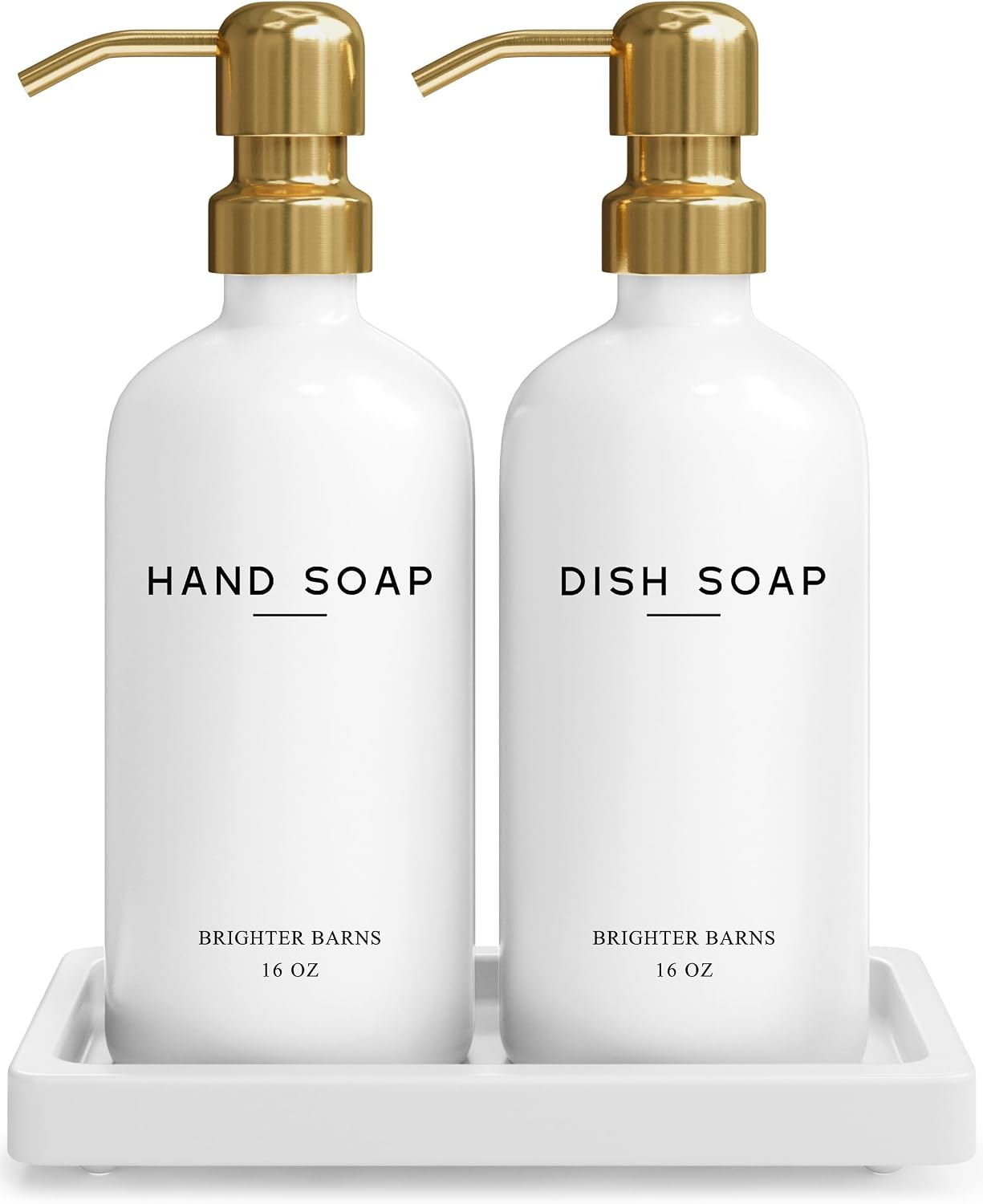
- Brighter Barns Luxury Gold Glass Hand & Dish Soap Dispenser Set for Kitchen Sink — $39.70
Related reading
Two other pieces on this site cover ground next to this one. Teak is used on boat decks for a reason, and that reason is exactly what makes it suitable above a bath. And on a related note, the constraint in most bathrooms is not space, it is that you cannot make holes in the wall.
- Teak in a bathroom: why it works and what it needs
- Small bathroom storage that does not need drilling
Why a mat that worked stops working
Loss of absorbency is nearly always residue rather than wear. Fabric softener and detergent build up on the fibres and waterproof them slightly, so the mat starts to feel like it is repelling water rather than taking it in.
A hot wash with no detergent at all, or a cup of white vinegar in the drum, strips that build-up and usually restores a mat that seemed to be finished. It is worth trying before replacing anything.
Ventilation matters more than the mat
In a bathroom with no extractor and a closed door, everything stays damp regardless of what it is made from. The mat gets blamed for a room problem.
Running an extractor for a while after a shower, or leaving the door open, changes the drying environment for every textile in the room. If mats keep going musty despite being washed and hung, the room rather than the mat is the thing to address.
Buying and keeping one
Choose dense chenille or microfibre with a breathable backing, size it to the floor space, hang it after use, wash cool without softener and dry low. Do that and a mat stays fresh for years rather than months.
Everything ships from Los Angeles, CA: $6.95 standard, nothing above $75, and a 30-day window for unused returns. Questions to [email protected].